Lej Sgrischus
A family fishing trip to a high alpine lake at the height of summer.

Summer solstice has been and gone. The snow that buried the 3000 metre peaks above Val Fex has long since receded, faster than usual. The glacier at Piz Tremoggia—Roger’s favourite mountain—crumbles slowly, almost unrecognisably, but irrevocably.
We meet at Furtschellas car park and take the cable car up the mountain. The same place we met many months ago in our search for soapstone on the alp. A group of elderly Swiss tourists stare at the strange spectacle of a British guy filming with a seemingly normal, local family. No context is provided.
Roger exchanges with his children in Romansh, in Putèr specifically—closely related to the Vallader idiom that inhabits the lower valleys, but expresses itself more sharply—as if to match the atmosphere of these higher altitudes.
With Martina, his wife, he switches to Swiss German. This constant merging of languages is a commonplace and in itself an art form. Chameleon-like. But Romansh, what Roger calls their “lingua secreta”, remains the most personal and passionate.
Clunk. The cable car reaches its destination halfway up the mountain. We disembark and begin the climb. I have no idea where we are going or how long it will take to get there.
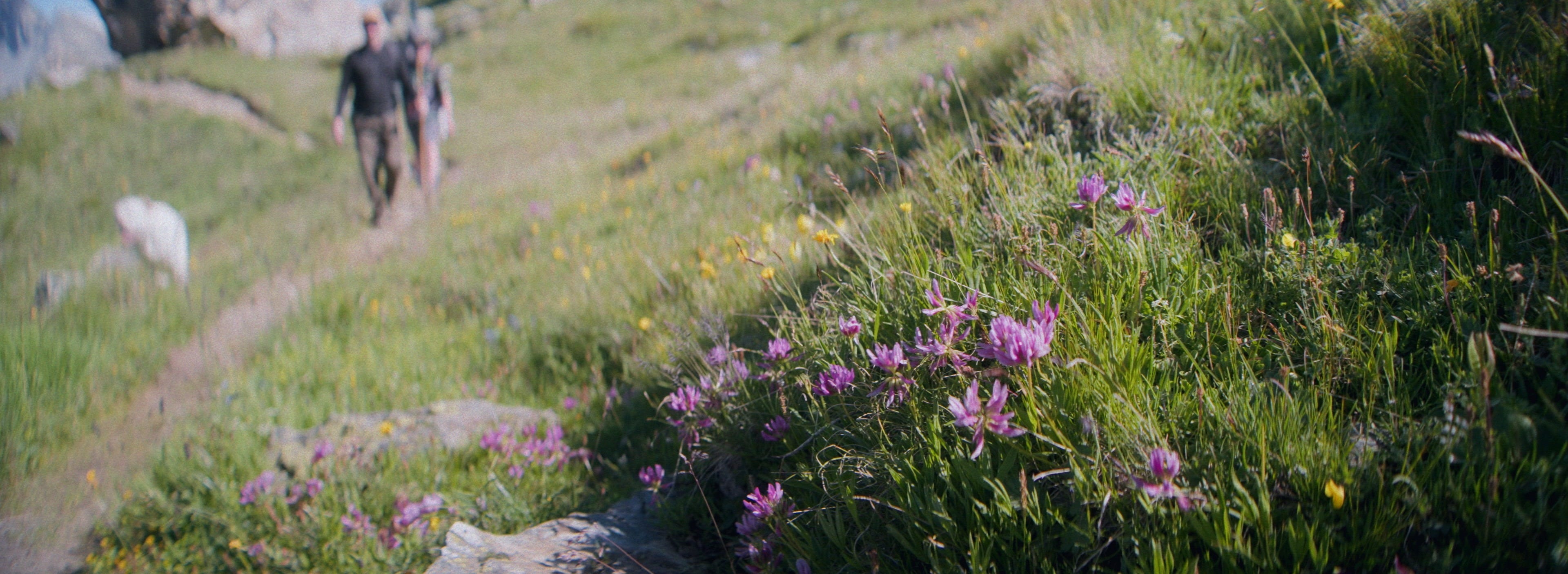
The sun rises early these days, but even at this hour of mid-morning, it stretches over the grassy slopes with a pleasing glow—illuminating the wildflowers, bountiful, whose names I do not yet know.
Our shadows cast over them, morphing with the terrain, a visual poetry that I am always drawn to.
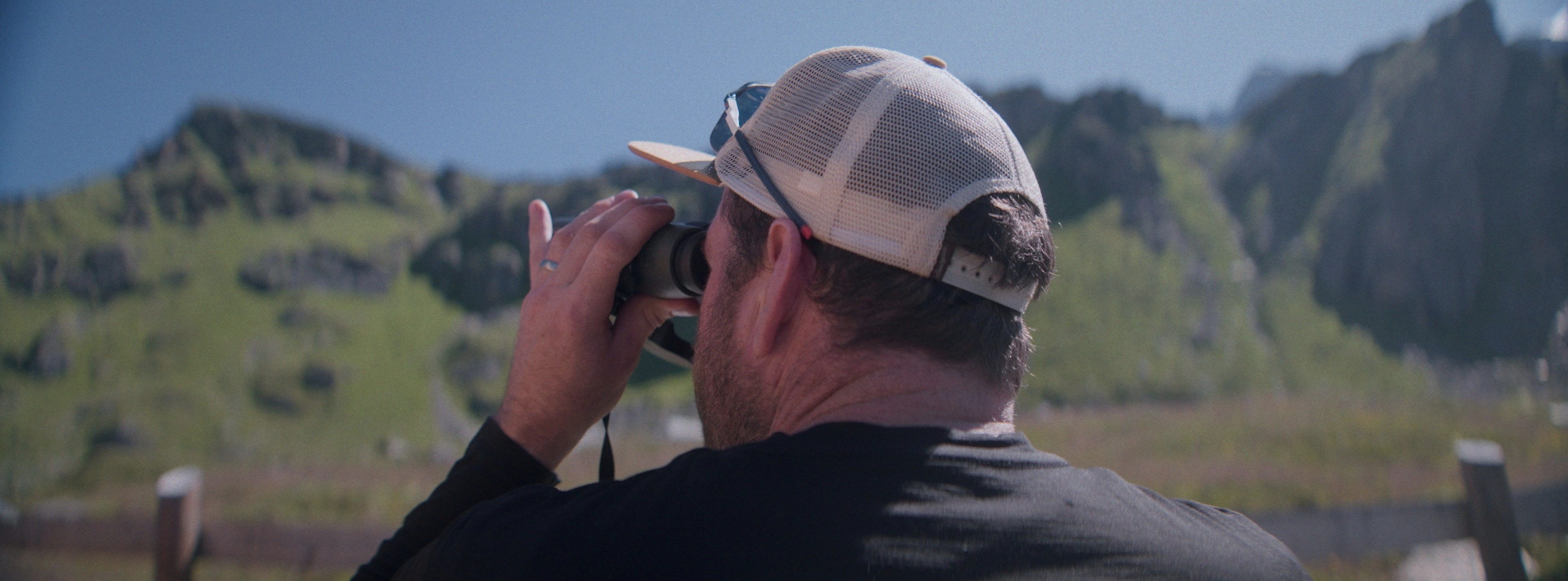
Every once in a while Roger stops and pulls out his Swarovski binoculars. The irony is wonderful, much like his playboy notebook in which he writes notes for his knives.
He raises his wooden hiking pole and points to the peaks, sharing his knowledge of the landscape with his children. Unremarkable to him, but from an outsider’s perspective, I recognise this as a rare quality of someone who truly knows this place.
I ask what he is looking at.
“Over here, the chamuotsch are around at this time of year…” he explains, studying the horizon.
The chamuotsch, or chamois, is something that appears frequently as a subject in our time together. Sometimes at his kitchen table, he spontaneously whips out his binoculars to study the scree slopes. Without romanticisation, the animals of these mountains appear to have a deep significance, beyond mere decoration.
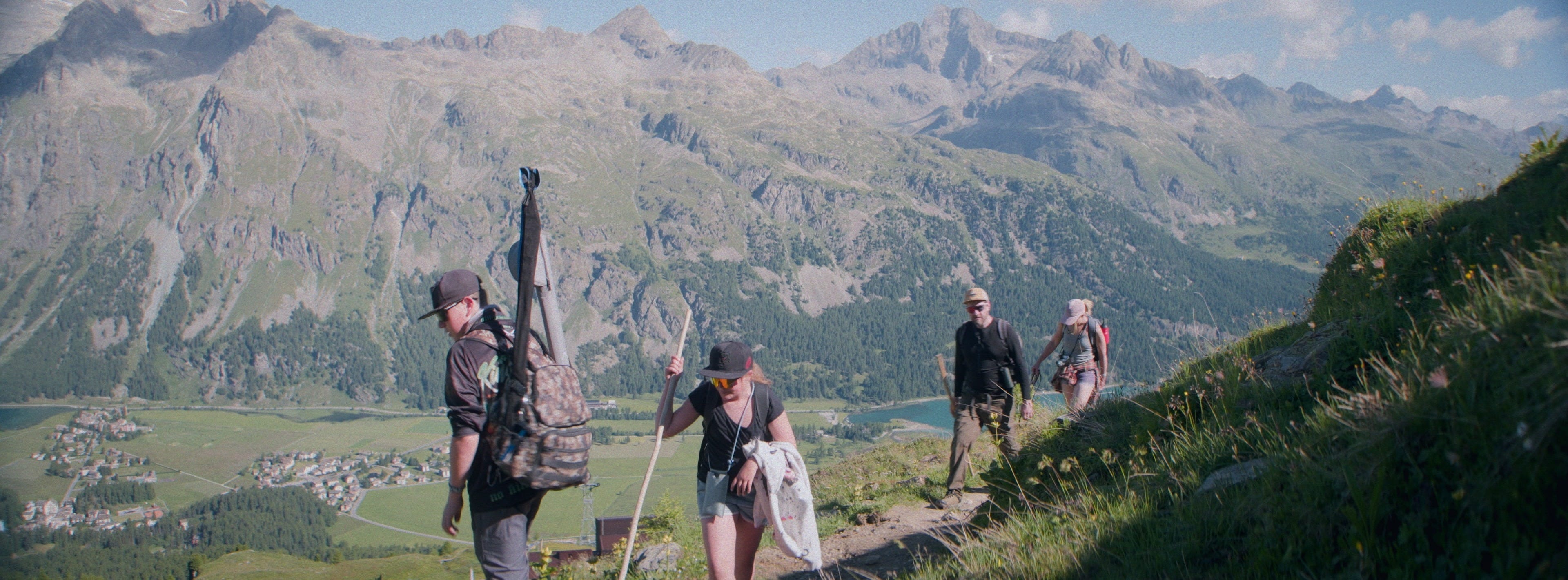
Sweat drips from our skin as we climb upwards. There is no shade, and although the alpine air keeps the temperature cooler, the sun seems to seep into everything.
I run ahead occasionally, finding the right positions. I note the position of the sun as Roger notes the position of the chamuotsch.
In the distance, the famous lakes of the Engiadin’Ota stand glistening, turquoise. The tourist’s gaze is hard to resist—and founded of course, in lived experience. The beauty is undeniable.
Sgrischus, our lake of destination today, sits well over the mountain. The path unfolds in layers, each time reaching the point seen by eye, and each time seeming quite a bit further.
The whole of Fex is visible now, and it is easy to see the attraction for holiday homes. It is the archetypal Swiss landscape—loved by people who mostly do not inhabit it.
Footsteps strike the dusty trail. Muntanella—marmots—whistle in the distance, warning their kin of our presence. Roger whistles back with precision accuracy. They stand frozen, expressions hard to read, probably confused by this strangely large and hairless creature, communicating in their language.
We stop and take a short break. Martina has her camera and takes a family photo. I take one of them altogether. For a moment. I feel that we ironically look a little like tourists.
The final stretch is the most impressive. A trail weaves its way around a small side valley, a waterfall pours down from a source which we cannot yet see. Below, a mineral-rich, small lake glows like a gemstone. Scree slopes surround us, binoculars study the ridges.
We are not the only ones here, much to Roger’s mild frustration. He expresses it in a half-joking way, but it is clear he is relieved in those moments when the place remains free of people.
We set up on the shore of the lake. Small fish dart along in the shallows. Roger and his son, Gian-Marchet begin preparing the lines. He pulls out a knife: the newest creation, a small blade with a horn handle—a chamuotsch, no less.
Martina begins to photograph it. Poised carefully on the edge of the rock, with the lake glistening in the background. This will be sold in the new summer shop, they tell me—at Chesa Rominger, built into a storage room by the front door.
Summer in Fex is crazy, they tell me. Hikers, horse carriages, mountain bikers. Tourists fill up the small valley roads. The valley is no longer entirely theirs. But for those who depend on it, the fame of the valley is a burden necessary to carry.
The family go off in different directions, choosing their position. Martina climbs slightly higher in search of the perfect position for the knife photograph. Roger moves around the corner, hidden, seeking space. Gian-Marchet and Marina stay with me, perched on the rocks, focused on the lake and the fish.
Silence pervades, other than the wind. As the hours pass, more tourists appear on the other side of the water. Clouds pass overhead, filtering light between shadow and full sun, and I watch them take shape, transform, disappear again.
Gian-Marchet catches a fish, but I am too far away to film it. I let the moment pass. He lets the fish go, since it’s too small to take.
On the way back, we stop at the Alp Munt, a mountain hut managed by two Tyroleans who are spending the summer up here. They bring products from their region of Austria by helicopter up the alp, and we indulge in apple juice, made sweeter through exertion.
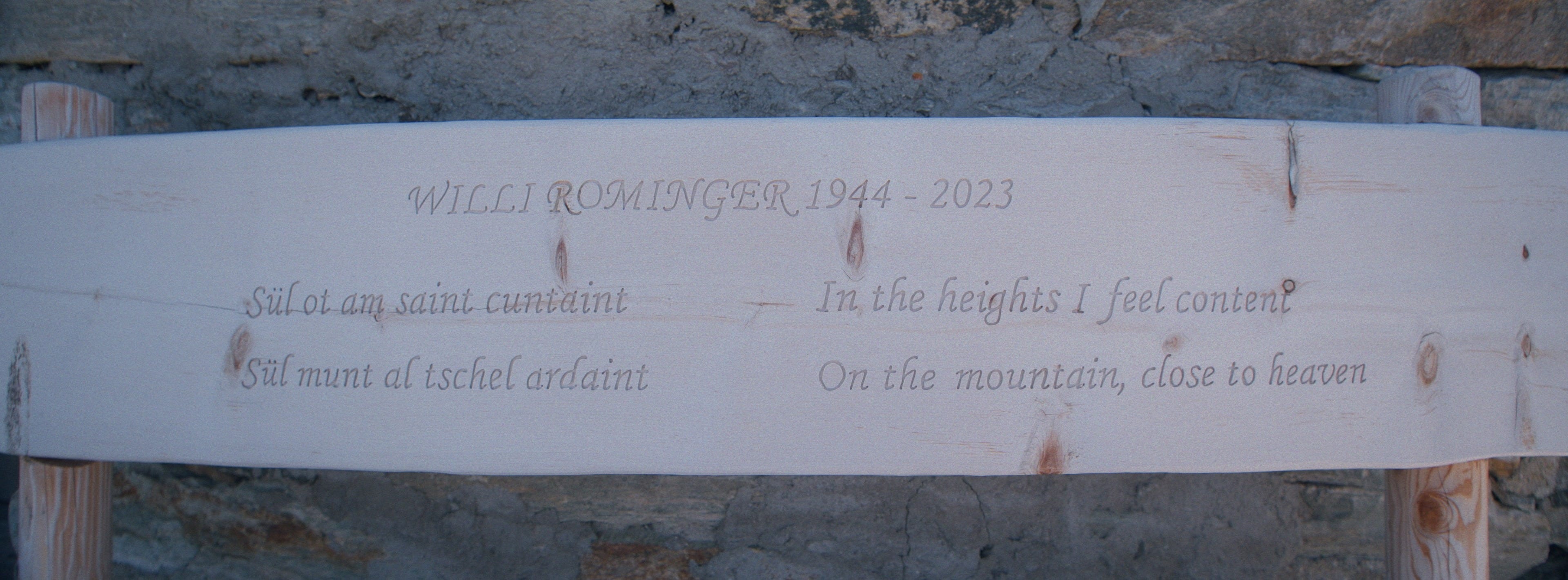
Glacial water flows from a spring. The alpine wind blows stronger now. A wooden bench made of stone pine bears the a memorial for the name “Willi Rominger”—Roger’s favourite uncle. Inscribed, it reads:
“Sol ot am saint cuntaint,
Sül munt al tschel ardaint”
In the heights I feel content,
On the mountain, close to heaven.